The concept of a community-wide residents’ meeting is coming up more and more often in discussions about municipal digitalization. It is also a clear focus within Handslaget, where the initiative “Basic Conditions for a Community-Wide Residents’ Meeting” (GSIM) is currently undergoing evaluation.
But what exactly is lacking today, and why are individual e-services and standalone solutions no longer sufficient?
The challenge today is not a lack of services
Most municipalities today offer numerous digital services. The real issue is how well they are connected – or rather, how disconnected they are.
From the citizen's perspective, it often involves:
-
- Many different entry points, each with varying appearances, languages, and logic
-
- Difficulty in getting a clear overview of one's interactions with the municipality
-
- Limited insight into the status, history, and decisions of ongoing cases
-
- No ability to represent children, relatives, businesses, or associations
-
- An experience that is fragmented and reactive, rather than cohesive and proactive
Citizens don't interact with administrations; they interact with life itself. This includes housing, business, family, school, building permits, and care. The digital experience rarely reflects this reality.
Municipalities share the same challenges.
GSIM clearly indicates that this is not an isolated system issue but a structural problem.
Many municipalities are grappling with:
-
- Different operational systems describing cases and their status in various ways.
-
- Data locked within systems, making it hard to share and use across different departments.
-
- A lack of a comprehensive view of citizens and businesses.
-
- No effective foundation for a unified citizen experience or a practical 'My Pages' portal.
At the same time, national initiatives are progressing. Projects like 'My Cases,' 'My Representatives,' contact information, notifications, and future national interfaces all depend on municipalities having their data and information well-organized.
A shared foundation instead of 290 individual solutions.
In our projects with municipalities, we observe that the needs are consistent, regardless of the municipality's size or structure. This is why we don't believe each municipality should build its own system from scratch.
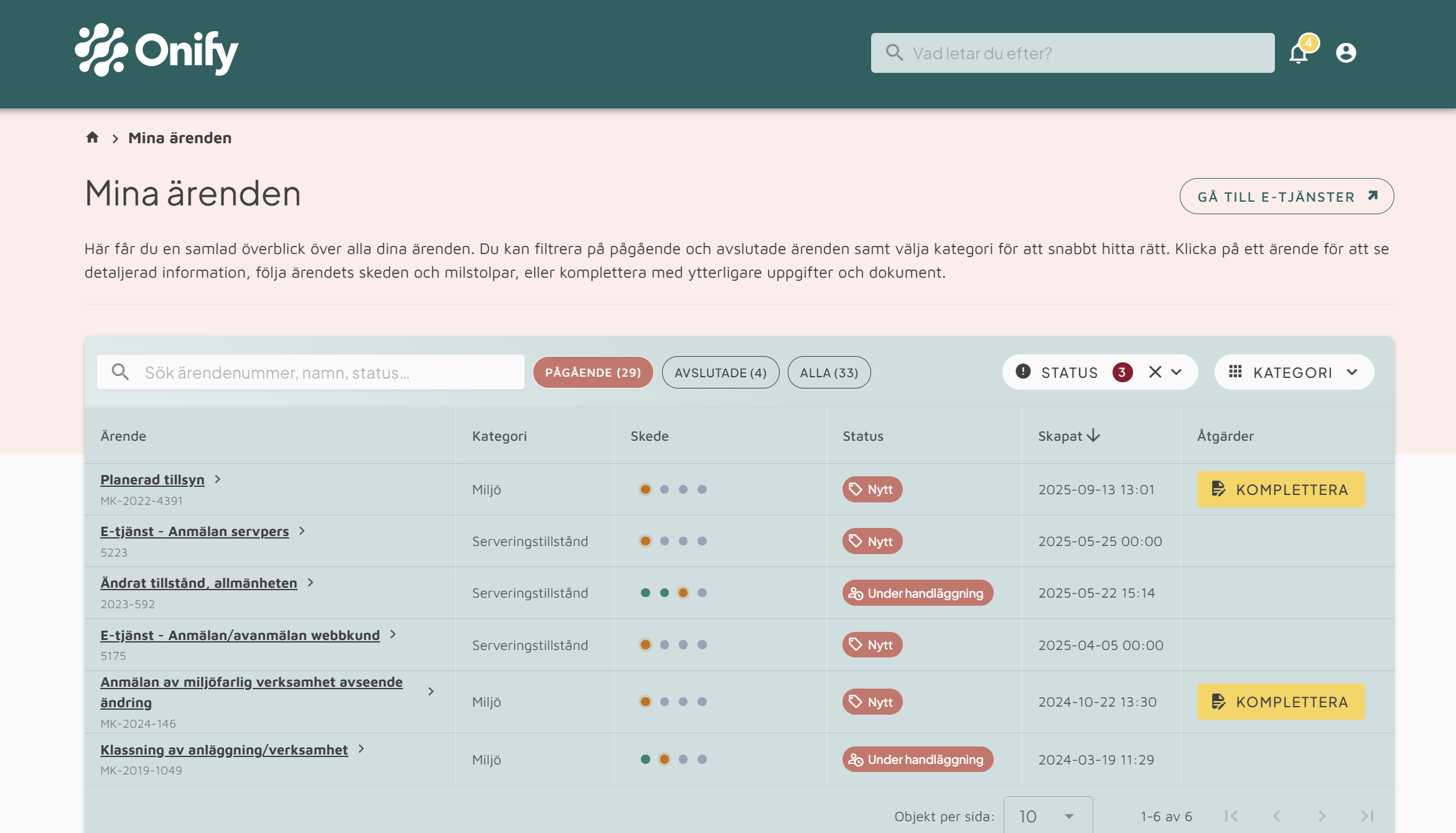
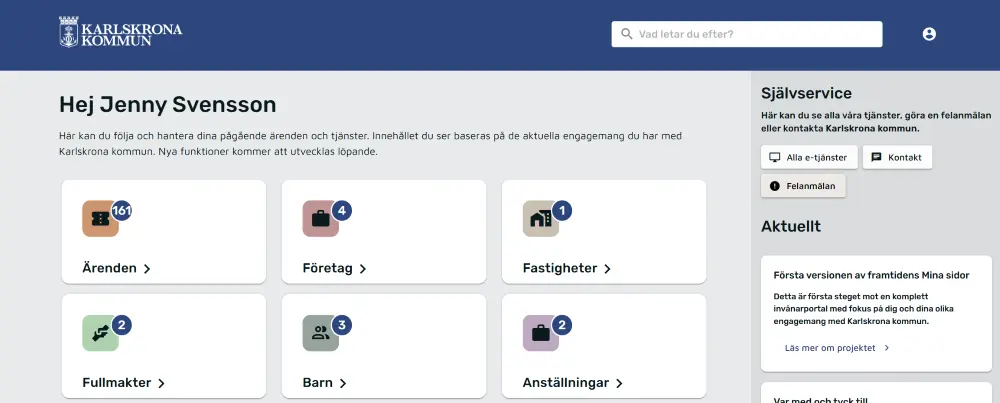
Together with municipalities such as Karlskrona and Lidingö, we are already working on the next generation of 'My Pages'. Not as a new business system, but as a neutral layer on top of existing systems.
This includes:
-
- A common portal that can be adapted with different levels of development and focus areas.
-
- A consistent view of all information, connecting citizens, businesses, properties, families, representatives, and cases.
-
- The same core structure, but with local customization for content, processes, and visual branding.
-
- A single, comprehensive view where all citizen-related information is available in one place.
This is fully in line with GSIM’s mission: to establish the conditions, standards, and working methods necessary to facilitate a unified resident meeting.
Start correctly, even if you begin on a small scale.
Creating a unified citizen experience doesn't require a massive rollout right away. In fact, it's often the opposite.
We've observed that the most successful municipalities:
-
- Begin by defining a few key priority areas.
-
- Map out the status, how information is structured, and the connections between different systems.
-
- Test the overall solution early on using a neutral interface.
-
- Build upon it gradually, based on feedback and real-world usage.
The key is to establish the correct structure from the start, before technology choices or procurement decisions limit future possibilities.
Our Vision for the Future
The Community Engagement Platform isn’t about a single product; it’s about creating a sustainable, shareable, and scalable foundation for how municipalities engage with residents and businesses digitally. GSIM sets the direction, municipalities provide the practical implementation, and our role is to put it into practice today.
If you'd like to see how this could work for your municipality, please feel free to contact us, and we'll schedule a discussion or a demo.